

How Web Development Helps Grow Your Business
August 21, 2026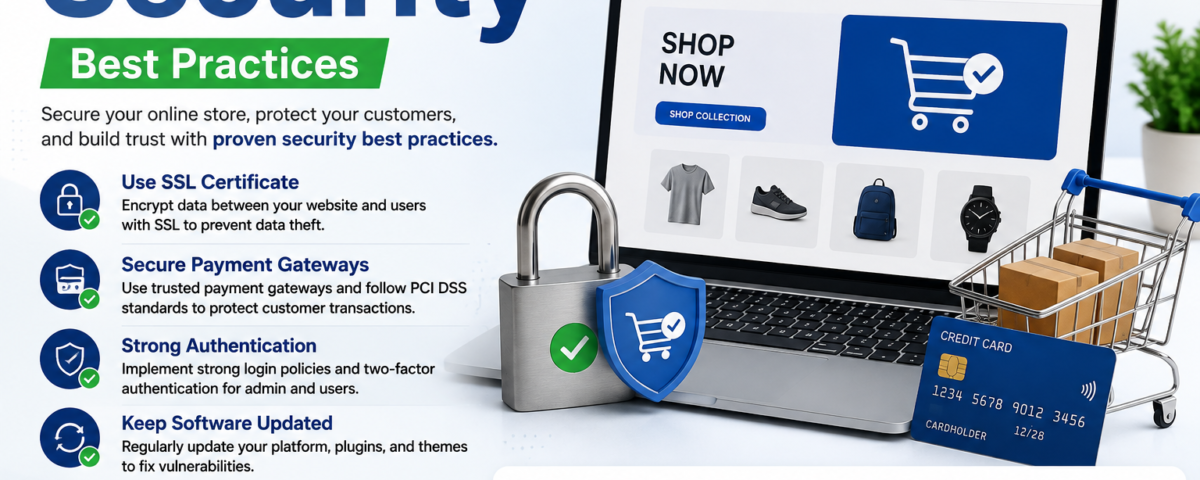
E-commerce Website Security Best Practices
E-commerce Website Security Best Practices
Introduction
E-commerce website security is essential for protecting customer information, payment data, business systems, and online transactions. As online shopping continues to grow, e-commerce websites are increasingly targeted by cybercriminals looking to steal sensitive information, compromise accounts, inject malicious code, or disrupt business operations.
A strong e-commerce security strategy protects both the business and its customers while building trust and supporting long-term growth. From using HTTPS and secure payment gateways to implementing multi-factor authentication and regular security testing, businesses should take a layered approach to website protection.
Why Is E-commerce Website Security Important?
E-commerce websites handle valuable information such as customer names, addresses, phone numbers, login credentials, order details, and payment-related information. A security breach can expose this data and lead to financial losses, legal issues, reputational damage, and loss of customer confidence.
Security is also important for maintaining website availability. Attacks such as distributed denial-of-service (DDoS) attacks can make an online store unavailable to customers, potentially resulting in lost sales.
Following e-commerce website security best practices helps businesses reduce these risks and create a safer shopping experience.
1. Use HTTPS and SSL/TLS Encryption
One of the basic requirements for e-commerce website security is HTTPS. A website should use a valid SSL/TLS certificate to encrypt data transferred between the customer’s browser and the web server.
HTTPS helps protect sensitive information from interception during transmission. It also allows customers to recognize that they are communicating with the intended website through a secure connection.
Businesses should ensure that all pages, not only checkout pages, use HTTPS and that insecure HTTP connections are redirected to HTTPS.
2. Choose a Secure Payment Gateway
E-commerce businesses should avoid handling sensitive payment information unnecessarily. Using a reputable payment gateway can help reduce the amount of payment data stored and processed directly by the website.
Payment providers typically offer security features designed for online transactions. Businesses should carefully evaluate their payment provider’s security capabilities, compliance requirements, fraud protection, authentication options, and integration practices.
Never store payment information unless there is a legitimate business requirement and appropriate security controls are in place.
3. Use Strong Authentication
Weak passwords can provide attackers with an easy way to compromise customer or administrator accounts. E-commerce websites should enforce strong password policies and protect administrative accounts with additional authentication controls.
Multi-factor authentication (MFA) is particularly important for administrator, developer, and other privileged accounts. MFA requires users to provide an additional verification factor beyond a password, making account takeover more difficult.
Businesses should also implement account lockout or rate-limiting mechanisms to reduce automated password-guessing attacks.
4. Keep Software and Plugins Updated
Outdated software can contain publicly known security vulnerabilities. E-commerce websites commonly rely on content management systems, shopping platforms, themes, plugins, extensions, payment integrations, and third-party libraries.
These components should be regularly updated and monitored.
Before installing a plugin or extension, businesses should evaluate its reputation, maintenance history, security practices, and necessity. Unused plugins and extensions should be removed rather than simply disabled whenever appropriate.
5. Protect Customer Data
Data protection should be a central part of e-commerce security. Businesses should collect only the information they genuinely need and avoid retaining sensitive information longer than necessary.
Sensitive information should be protected using appropriate encryption and access controls. Databases, backups, application servers, and administrative systems should all receive appropriate protection.
Access to customer data should follow the principle of least privilege, meaning employees and systems should only have access to the information required for their responsibilities.
6. Prevent Common Web Application Attacks
E-commerce websites should be designed and tested to defend against common web application vulnerabilities.
Important security risks include:
- SQL injection
- Cross-site scripting (XSS)
- Cross-site request forgery (CSRF)
- Broken authentication
- Broken access controls
- Insecure file uploads
- Security misconfiguration
- Session-related vulnerabilities
Developers should use secure coding practices, input validation, output encoding, parameterized queries, secure session management, and appropriate access controls.
Security testing should be performed throughout the development lifecycle rather than only after a website is launched.
7. Implement Web Application Firewalls
A Web Application Firewall (WAF) can provide an additional security layer between users and an e-commerce application. A WAF can help identify and block certain malicious requests before they reach the application.
A WAF should not be considered a replacement for secure coding. Instead, it should complement application security, network protection, monitoring, and other security controls.
8. Use Secure Admin Controls
Administrative accounts have significant privileges and therefore require stronger protection than ordinary accounts.
Businesses should use unique administrator accounts, strong passwords, MFA, restricted access, and secure administrative URLs where appropriate. Administrative access should also be monitored for suspicious activity.
Unused administrator accounts should be removed, and permissions should be reviewed regularly.
9. Secure APIs and Third-Party Integrations
Modern e-commerce websites often depend on APIs and external services for payment processing, shipping, marketing, analytics, inventory, customer support, and other functions.
Every integration introduces potential security considerations.
API endpoints should use appropriate authentication and authorization, validate input, apply rate limits, and avoid exposing unnecessary information. API keys, access tokens, and other secrets should never be hard-coded into publicly accessible code.
Third-party services should also be reviewed periodically to ensure that they remain necessary and appropriately secured.
10. Perform Regular Security Testing
Regular security assessments can help identify weaknesses before attackers exploit them. E-commerce businesses should consider vulnerability scanning, code reviews, penetration testing, dependency checks, and configuration assessments based on their risk profile.
Security testing should cover both the website and supporting infrastructure.
After vulnerabilities are discovered, businesses should prioritize remediation according to severity and business impact. Fixing a vulnerability is only part of the process; organizations should also verify that the fix works and does not introduce new problems.
11. Create Reliable Backups
Backups are an important defense against data loss, ransomware, accidental deletion, system failures, and other incidents.
E-commerce businesses should maintain regular backups of critical website files, databases, configurations, and other essential information. Backups should be protected from unauthorized access and, where appropriate, isolated from production systems.
Businesses should also test restoration procedures. A backup that cannot be successfully restored may not provide meaningful protection during an emergency.
12. Monitor Website Activity
Continuous monitoring can help businesses detect suspicious behavior quickly. Security logs should record relevant authentication events, administrative actions, system changes, and other important activities.
Organizations can monitor for unusual login attempts, unexpected account changes, abnormal traffic, suspicious transactions, and unauthorized modifications.
Early detection can reduce the potential impact of a security incident.
13. Protect Against Online Fraud
Website security and transaction security go hand in hand. E-commerce businesses should use appropriate fraud detection and transaction monitoring controls.
Depending on the business model and payment provider, useful measures may include transaction limits, address verification, risk scoring, velocity checks, and additional authentication for suspicious transactions.
Fraud controls should be balanced carefully so that legitimate customers are not unnecessarily blocked.
14. Educate Employees and Customers
People are an important part of e-commerce security. Employees should understand phishing, password security, social engineering, suspicious links, data handling, and account security.
Customers can also benefit from clear guidance about creating strong passwords, recognizing legitimate communications, and protecting their accounts.
Security awareness should be an ongoing process rather than a one-time training session.
15. Prepare an Incident Response Plan
Even well-protected websites can experience security incidents. An incident response plan helps businesses respond quickly and consistently when something goes wrong.
The plan should define responsibilities, communication procedures, containment steps, investigation processes, recovery procedures, and appropriate notification requirements.
Organizations should periodically review and test their incident response plan so that employees understand what to do during an actual incident.
Conclusion
E-commerce website security requires more than installing an SSL certificate or using a secure payment gateway. Businesses need a layered approach that combines encryption, secure authentication, software updates, data protection, secure development, monitoring, backups, security testing, and employee awareness.
By following these e-commerce website security best practices, online businesses can reduce cybersecurity risks, protect customer information, maintain website availability, and build greater trust with their customers.
Security should be treated as an ongoing process. As technologies, threats, integrations, and business requirements change, e-commerce websites should continuously review and improve their security controls.
